

Tailored engine management optimisation · On-site service
Your duty cycle.
Our calibration.
Short trips. Frequent pull-aways. Heavy loads. We optimise your truck’s engine management around its working day, focusing on fuel consumption, power delivery and torque. At your premises.
Start with selected trucks in your own operation. Use the results to decide what comes next for the fleet.
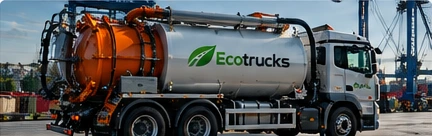
ECOTRUCKS
1 L
All savings shown are modelled estimates. Actual savings must be measured under comparable operating conditions.
Benefits
Power for the task.
A benefit you can assess.
Optimisation should suit your work. We therefore combine individual calibration with a trial in real operation.
Learn more ↗ECOTRUCKS
Calibrated for the work.
Built around the duty cycle.
Vehicle, route, load and working routine belong together. They provide the starting point for an individual calibration.
Short trips and stop‑and‑go
Many short driving sections, repeated braking and pulling away: we consider the recurring situations on your routes rather than treating steady long-distance driving as the benchmark. This describes the truck’s working rhythm, not a blanket change to an automatic start-stop system.
Torque where the job needs it
Pulling away, carrying a load and handling changing routes place different demands on torque delivery. We consider the operating ranges relevant to your work. Suitable and technically feasible changes are assessed for the particular vehicle.
Power with a purpose
Peak output alone does not define a useful working calibration. Our objective is power delivery suited to the task. Driveability, required work output and consumption are considered together.
ECOTRUCKS / PILOT
We come to you.
You test in daily operation.
Your own operation is the practical starting point for a first assessment. Together we select suitable pilot trucks and agree the on-site visit and scope of optimisation. The vehicles then carry out their real duties, creating a basis for decisions drawn from your working day.
- Select pilot trucks that represent typical duties
- Record baseline consumption and operating conditions
- Review consumption, driving behaviour and driver feedback together
Vehicle count, test duration, price, travel and technical prerequisites are agreed in advance. A pilot is not automatically free of charge.
Ecotrucks
We come to you.
You test in daily operation.
Your own operation is the practical starting point for a first assessment. Together we select suitable pilot trucks and agree the on-site visit and scope of optimisation. The vehicles then carry out their real duties, creating a basis for decisions drawn from your working day.
ECOTRUCKS / CO₂
Less diesel.
Lower direct CO₂ emissions.
Every litre of diesel actually avoided for comparable work also reduces direct CO₂ emissions. That links economic value with a tangible reduction in fuel use.
Start with litres
The volume of diesel saved is the starting point. In the pilot we compare consumption with work performed; in the calculator you choose the assumed reduction.
Make the CO₂ estimate transparent
The example calculation uses approximately 2.65 kg of direct CO₂ per litre of diesel. Avoiding 1,000 litres therefore corresponds to around 2.65 tonnes less direct CO₂ in this model.
Consider the whole fleet
Modest changes per vehicle can add up across trucks and working days. Annual results in the calculator help put the possible scale in context.
CO₂ figures estimate direct combustion using a rounded modelling factor. Fuel composition and blending affect the actual value. Upstream emissions, other greenhouse gases and vehicle manufacturing are excluded. Lower fuel use does not prove reductions in NOx or particulates and does not make a truck climate-neutral.
Calculate fuel and CO₂ ↗